Japan, Germany, and the Rest of Us – Björn-Ole Kamm’s Role-Playing Games of Japan: Transcultural Dynamics and Orderings
Jukka Särkijärvi
Björn-Ole Kamm, associate professor in Transcultural Studies at Kyoto University, wrote Role-Playing Games of Japan: Transcultural Dynamics and Orderings originally as a PhD thesis that he defended in 2015, which was then adapted into a book and released by Palgrave-Macmillan in 2020. As with previous Palgrave publications in this series, it is obscenely expensive. Fortunately, they have occasional sales campaigns that lower price tags to the reach of mere mortals, and I can tell you everything. Kamm was also the keynote speaker of Ropecon’s academic seminar in 2021.
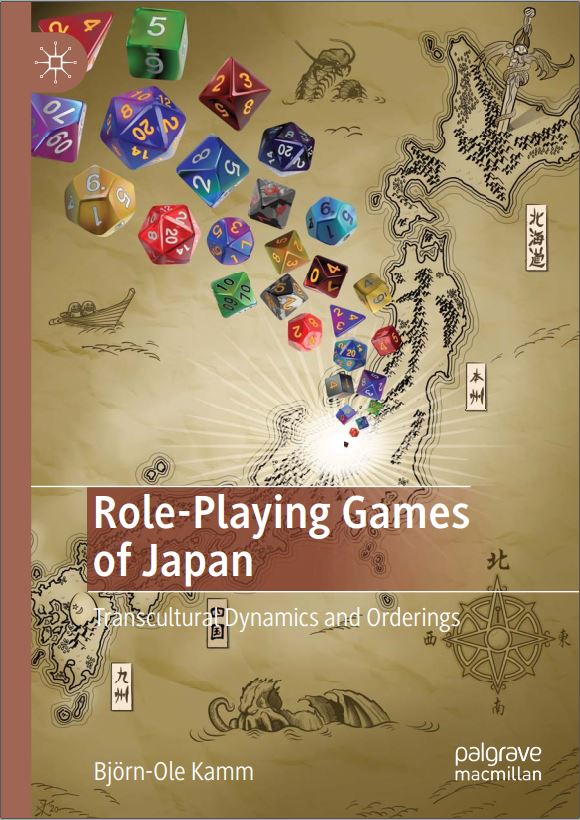
The title creates the expectation for a history of Japanese role-playing games, that old and well-known yarn about Dungeons & Dragons, Record of Lodoss War, Sword World and light novels, but the work is far more complex. For once, the key to the puzzle is in in the subtitle. Most of the book’s 300 pages is Kamm’s coverage of the channels of cultural exchange both between Japan and the West as well as within Japan. Through interviews, the book breaks down the Japanese otaku stereotypes as well as the Western image of the nerd.
Role-Playing Games and Japan
The first Japanese role-playing game was named Rōzu tu rōdo (”Roads to Lord”). It was written by Kadokura Naoto and released in 1984. Unlike the first tabletop role-playing games in many other language areas, it bore no resemblance to Dungeons & Dragons and, among other things, did not define player characters through number values. The game was entirely played out as a conversation building upon sentences provided by the rulebook. However, in a few years Rōzu tu rōdo was overshadowed by Sword World, designed by Kitazawa Kei and drawing heavily from D&D. Though D&D had been translated to Japanese in 1985, Sword World overtook it in popularity, partly because its price tag was 640 yen as opposed to D&D’s 4 800 yen. Sword World also used only normal six-sided dice. It was designed accessibility first, which Kamm notes was a common trend in early Japanese role-playing game design. Another example is 1993’s Tōkyō NOVA, which utilizes a normal deck of playing cards.
The biggest moneymakers of the Japanese role-playing game industry are a local specialty – the replay. They are transcriptions of game sessions edited into novels. Unlike titles such as the Dragonlance novel Dragons of Autumn Twilight, which is also based on events at the game table, the Japanese replays present the dialogue of both the game master and the players and also include dice rolls. The closest equivalent in Western role-playing games is the example of play familiar from many rulebooks, except that instead of a page or two, the replays are entire books. The ninja game Shinobigami, also available in English, is given as a good example of the form – the first half of the rulebook, about 80 pages, is replay.
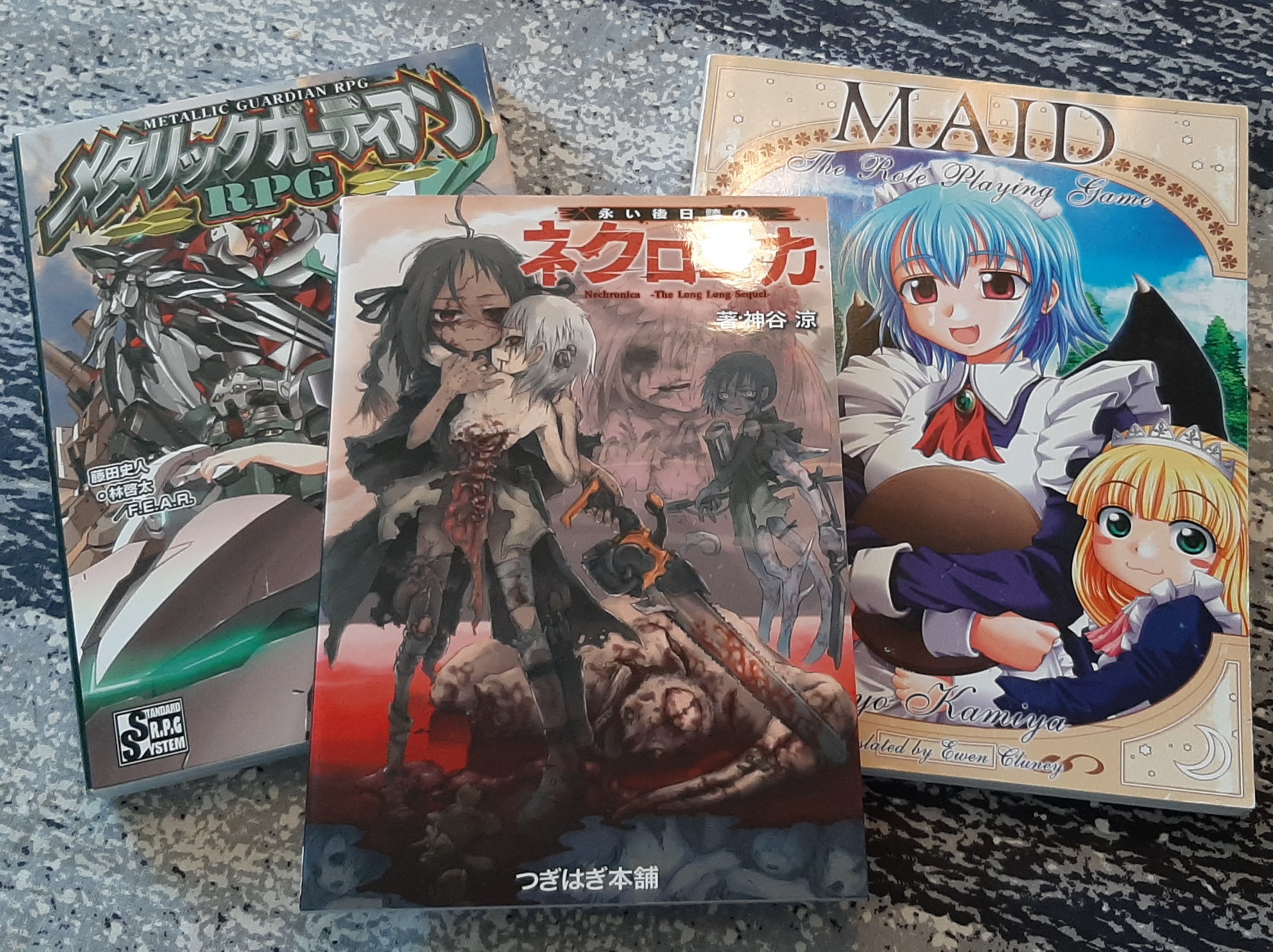
As in Finland and Kamm’s example country, Germany, Japan also had a role-playing game book in the late 1980’s and early 90’s, which then quieted down over the latter part of the decade and rose again well into the 2000’s. In 2008, we also got the first Japanese role-playing game in English. It was Kamiya Ryō’s comedy game Maid RPG (originally released in 2004). Later translations include Tenra Banshō (1996, translated 2014), Ryūtama (2007, translated 2015), and Shinobigami (2009, translated 2019). Practically all games translated from Japanese to English are the work of either Ewen Cluney or Andy Kitkowski. There are thousands of Japanese role-playing games, but bringing them outside the language area is on the shoulders of a small number of creators. Unfortunately, the most interesting-sounding game, Koaradamaru’s 2012 release Isamashī chibi no suihankia, (“Brave Little Rice Cooker”) has not been translated. [Translator’s note: since the first publication of this article, the game was translated by Björn-Ole Kamm and the translator has had the privilege of both playing and running it. The game is still not available to general audiences in English.]
Translations to Japanese include D&D, Shadowrun, and most notably Call of Cthulhu, which many sources name the most sold role-playing game in Japan. According to Chaosium’s Lynne Hardy, Ropecon’s guest of honour in 2019, when the company hit a difficult spot some years ago, Japanese sales kept them afloat.
These nodal points of cultural exchange are the main topic of Kamm’s book. The work also explores why Japanese gamers don’t hang out online with non-Japanese role-players even when the language barrier is not an obstacle, and it’s not easy for Japanese-speaking Westerners to get into the scene. According to the research, most Japanese gamer communities used a local platform called Mixi, which required a Japanese mobile phone number, which you can only get if you live in Japan. Of late – at the time of writing – discussions had moved increasingly to Twitter. Though Twitter’s format is a direct act of violence towards human communication in any language that uses an alphabet, 280 kanji may be sufficient for nuanced expression. Another platform is the Japanese TRPG.net.
There have been attempts at bringing role-playing games from Japan to Europe and for example, the game designer Kondō Kōshi has visited the SPIEL game fair in Germany to run games and network with business partners who might facilitate printing games in the EU and avoid tariffs. However, at the time of writing, no deals had been yet struck.
Larping is a new phenomenon in Japan. Kamm tracks its pedigree in great detail, back to the Castle Tintagel games run by the German Nico Stahlberg and the American Jay Noyes in 2011 and 2012. Tintagel also displays the clash of American and European larp cultures. Stahlberg was motivated by the idea to spread larp as a form of expression across Japan and teach locals how to run their own games, while Noyes wanted to sell tickets and market his swordfighting school. He was also worried about copyright – who owns the stories of the games? According to Noyes, “free” is not interesting in Japan the same way it is in the United States. The thinking goes that if it doesn’t cost anything, it can’t be worth anything.
However, Stahlberg negotiated the license for the German DragonSys larp ruleset and its free distribution in Japanese. Together with Japanese gamers, a gameworld was built around the ruleset. It was named Patoria Sōrisu (”Patria Solis”). The players and game masters who learned to larp at these games have spread the artform across the archipelago and in under a decade, Japan developed its own, small larp culture. Horror has arisen as a popular genre, in part because of low propping demands.
What Are We Talking About When We Talk About Japan?
Throughout the text, Kamm questions and analyses the roles of different actors in the cultural exchange and how they construct or deconstruct certain ideas about “Japaneseness”. Lurking in the background is also the Japanese state’s own Cool Japan brand strategy and the image it has constructed of the country over the past few decades. Kamm joins the ranks of its critics.
Writers in the Japanese RPG industry have done their own work in dismantling these prejudices. In the early editions of the fantasy cyberpunk RPG Shadowrun, Japan was presented as an empire that oppressed metahumans – the elves and dwarves and orks of the gameworld. However, in the Japanese sourcebook Shadowrun Tokyo, published by GroupSNE, Egawa Akira rewrote Japan as a weak state ruled by megacorporations. This, in turn, was panned by the local audience. Nishio Gen’ichi, a fan of the game, founded the JIS-Project, which harnessed the fanbase to rewrite the Japanese Imperial State, closer to the original but in a way that its creators considered more interesting. According to Kamm, this is the version of the Japanese Imperial State that has existed in the game since the fourth edition.
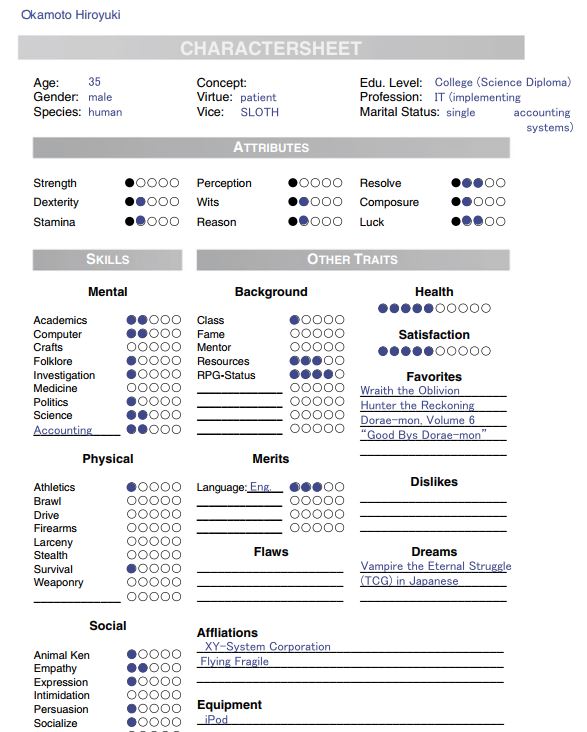
Kamm makes extensive use of interviews. The interview materials include character sheets that he asked his interviewees to fill out. The sheet is based on the World of Darkness character sheet, because it is familiar to most gamers and quite intuitive. This is one of the clear trends of 2020, because a similar sheet appeared in the Solmukohta book What Do We Do When We Play as a humorous self-evaluation form.
Role-Playing Games of Japan is a comprehensive work, but at times it feels like it is trying to bite off more than it can chew. Constraints of space elide nuance, and the book ends up making the claim that all Dragonlance novels from the years 1984 to 2011 are based on role-playing game sessions. The language is sometimes unclear, which makes the content subject to some interpretation. However, its literature review of Japanese scholarship is immensely valuable and in terms of width and breadth, every other history of Japanese role-playing games that I have read vanishes into a footnote. Role-Playing Games of Japan is definitely recommended reading.

