What’s It Like to Be There? – Nicholas J. Mizer: Tabletop Role-Playing Games and the Experience of Imagined Worlds
Jukka Särkijärvi
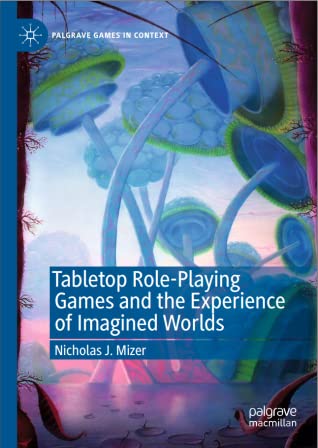
Nicholas J. Mizer’s book Tabletop Role-Playing Games and the Experience of Imagined Worlds came out in 2019 as part of Palgrave Macmillan’s Games in Context series. The past few years have been a fruitful time in academic role-playing game scholarship, and it has been refreshing to see these monographs coming out from other publishers than McFarland. A release from a serious academic publisher will, of course, also carry a serious price tag and the 174-page book fetches an eye-watering 93€ at the publisher’s webstore. Fortunately, Palgrave Macmillan has about once a year a discount campaign for those of us not spending the library’s acquisitions budget. My personal copy came from the author himself, and now I can tell you all about it.
Mizer’s background is in anthropology and folkloristics, and he describes his research as a phenomenological ethnography. The research question shifts along the way, but put simply, Mizer is looking at how role-playing games create worlds. Not written worldbuilding, but how players create the world through shared storytelling during a game session. The research subjects are four very different gaming groups around the United States, whose games Mizer participated in during the research period. They are all broadly in the sphere of the Old School Renaissance, in that they play very old editions of Dungeons & Dragons or retroclones based on them. Mizer studied a couple of conventions and conducted tens of interviews, in addition to participating in game sessions both at cons and at homes, as well as observing sessions from the outside, while of course recording everything. The book mentions that transcribing these recordings was especially rewarding.
Mizer got a big chunk of his funding on Kickstarter in 2013, where the project was still called The Greatest Unreality: Story, Play, and Imagination in D&D, and it was his doctoral dissertation. The project also included a vlog series named Spot Check, which remains on YouTube for posterity. This book is an updated version and contains some fresher sources. The research materials do show their age, however, and the field of role-playing games that they describe changed a great deal in the intervening six years, especially in the Old School Renaissance scene. The book contains a long bit about the fourth edition of Dungeons & Dragons and how it “mcdonaldizes” the gaming experience, but the fifth edition, out in 2014, is barely mentioned. The bibliography contains dead links, some of which have been last checked as early as 2012.
However, the book’s point is not to write a history but to discuss what it is that we’re actually doing when we play and immerse ourselves in these other worlds. The book contains a couple of introductory chapters that go over the research question, the methodology, theoretical foundation, and background, after which come three chapters of Mizer telling about his field research – meaning that part where he went and played a lot of games with other people.
The first field research chapter is almost bragging. Mizer tells about his trip to Gary Con. Gary Con is named after and dedicated to Gary Gygax (1938-2008), the father of Dungeons & Dragons, that takes place annually in his old home village of Lake Geneva, Wisconsin. The convention is one of the central events of the Old School scene and is frequented by both Gygax’s old gaming buddies from the 1970s as well as old TSR’s game designers. Mizer managed to get an invitation to Gary’s son Ernie Gygax’s gaming table. He had not run a game for over ten years. Mizer describes the session as memory work, even historical re-enactment.
The wildest part of the book is a chapter on games in Denton, Texas, where Mizer spent a few weeks and played a three-session mini-campaign. It was trippy science fiction. Mizer describes the DM as a “shaman” and even comes up with the term “chromomancer”, from her style of using colours as a central element in her descriptions. The DM herself characterizes running the game as forcing the fictitious reality inside her head into a physical space. In her own words, she “kidnaps reality and holds it as hostage for two hours”.
The third field research chapter discusses two long campaigns, played in New York and Portland, Connecticut. On the night of Mizer’s arrival in town, the New York campaign had its 200th session. The Portland campaign had run for 18 years. Mizer uses these campaigns to illustrate the richness that fictional worlds accumulate as players keep co-creating and bringing their own material to the table. Both campaigns also had documentation between game sessions – in one, a campaign wiki, in the other a DM’s notebook that tracked things like the campaign world’s calendar. Every player character of that campaign even had a birthday. The world was the main character in these games – in the old school spirit, characters died regularly. The Portland campaign had over 60 dead characters.
Each field research chapter has a lot of direct transcription from dialogue during game sessions, explanations of game worlds, and even war stories from the games. The tone is sometimes chatty, a gamer talking about the stuff they’re into, but then the next subheader hides a wild Heidegger and we’re off again. The structure is sometimes slightly chaotic, and the book draws from a very broad theoretical base. Following the thread is at times challenging unless one is already familiar with the material. I was not, and ended up acquiring an introduction to phenomenology in order to understand the book. Mizer also does not present one clear argument, and rather presents a variety of ways in which the fictional worlds exist. The list is not even exhaustive, and in the final chapter, Mizer is already looking to the future and new worlds.
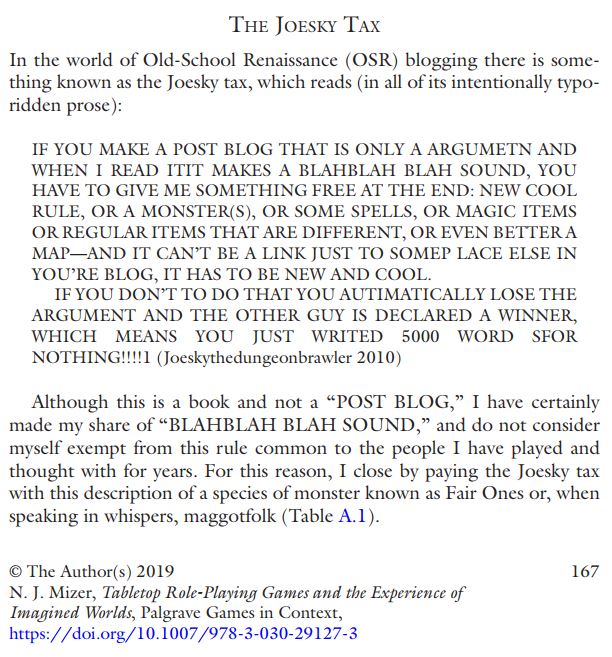
Despite its dry title, Tabletop Role-Playing Games and the Experience of Imagined Worlds is a fascinating work and does not forget playfulness. It is the only peer-reviewed work I’ve ever seen pay the Joesky Tax.
This piece was first published at roolipeliloki.com, on March 23rd, 2021. Translated by the author.
 Akateemiset pelaajat ry