At the Roots of Role-Playing Games – Jon Peterson’s The Elusive Shift
Jukka Särkijärvi
It is a well-known piece of trivia that when the very first version of Dungeons & Dragons was released back in 1974, its subtitle was “Rules for Fantastic Medieval Wargames”. The words role-playing game were nowhere to be seen. However, the fanzines that quickly popped up around the game referred to it as such very quickly, and a few years later TSR’s own Metamorphosis Alpha branded itself a role-playing game. But where did the phrase come from? What did it mean?
Jon Peterson’s book The Elusive Shift: How Role-Playing Games Forged Their Identity came out in late 2020 from The MIT Press. It clocks in at 336 pages. Peterson gained his reputation in 2012 with a doorstopper of nearly 700 pages, Playing at the World: A History of Simulating Wars, People and Fantastic Adventures, from Chess to Role-Playing Games. It is a deep dive into the predecessors, inspirations, and influences that led to the birth of Dungeons & Dragons, largely sourced from period fanzines. He has now returned to the topic, this time with an academic publisher and a clearer research question. The Elusive Shift defines itself as “para-academic”. Though its historical research is largely based on period sources, it also touches on more modern game studies. For the most part, Peterson keeps his own analysis concise and lets the primary sources speak.
The Elusive Shift digs into the 1970s discourse on the nature and theory of role-playing games. Like Playing at the World, it draws most of its content from fanzines. The workload is massive – the printings were small and their paper and binding usually cheap. Merely tracking down the material has been difficult. Dating it is an art of its own – fanzines often presented all sorts of claims about regular publishing schedules, which were often fanciful. Fortunately, zines were collected in university libraries and private collections, and in recent years some have even been digitized. For example, the full run of Lee Gold’s Alarums & Excursions, from 1975 to present day, 577 issues as of December 2023 all told, can be ordered in PDF from the editor herself.
What Came Before
The story of role-playing games begins among wargamers long before Dungeons & Dragons. Games like the British Western Gunfight test the limits of the form, such as by having each player control only a single character instead of an army. Among Western Gunfight’s fans, the hook of the game was not in winning but in playing “like the character would really act”. Already in the 1960s, Wargamer’s Newsletter dropped the phrase in character in conjunction with the game. The very core of its nature was questioned in an article titled “Yes, But Is It Really Wargaming?” Similarly, the a mail-based variant of the board game Diplomacy called Slobbovia had rules that made winning the game next to impossible, and a core activity was the players writing their countries’ propaganda for the game’s journal.
Not all early role-players came from wargames, however. The science fiction fandom, as is their wont, was in on it from the start. They also had experience with role-playing-adjacent activities, such as historical re-enactment. The Society for Creative Anachronism was founded in the 1960s by a group of Californian science fiction authors and fen. Unsurprisingly, an interest arose in the fandom towards D&D’s potential as a vehicle for storytelling. Many of the early female players, such as Lee Gold, came from the fandom, and The Elusive Shift quotes them at length. Of course, there are also the occasional men afraid of cooties.
The More Things Change…
Many of the discussions on the pages of fanzines and later commercial publications like The Dragon and Different Worlds look familiar to the modern reader. Only a few years after Dungeons & Dragons came out, it was bemoaned how D&D was being used as a metonym for all of the role-playing game hobby. There were ponderings upon whether role-playing games were an art form and how they functioned.
At least some ideological strains have died out since then. A long discussion in the early days was about whether the players are allowed to know the rules of the game or if it is the duty of the Dungeon Master to keep them secret, right down to dice rolls and the player characters’ hit points. This comes from the origins of wargaming and Kriegsspiel (1812), where an umpire handled the rules and adjudicated the players’ commands to their armies.
Some wargamers resisted the idea of “role-playing” because “doing things the way the character would do” resulted in suboptimal decisions in the dungeon, which was a lethally dangerous environment. There wasn’t necessarily anything outside the dungeon, and some players considered cities, taverns, and shops as irrelevant distractions. Some used “role-playing” to denote a playstyle where the player characters were never in any danger and the dungeons were amply stocked with treasure. The young hobby was still seeking its form and terminology was yet to set in stone. Even Gary Gygax said that D&D was not so much a game as it was a toolkit for building a game. The DM was supposed to take the rules, make them their own, and change them to fit their vision. The zines also published different rules variants, new monsters, and all the other stuff that readers of Dragon in later years could expect.
Sometimes things got really wild. In Alarums & Excursions, Bob Frager introduced guided meditation as a character creation method. In The Dragon, Douglas P. Bachmann conceptualized the role-playing game as a ritual that allowed the player to leave behind the quotidian world and connect with “Faerie”, to reach for the deepest mysteries of life and humanity. To aficionados of Nordic larp discourse, this is of course not an unfamiliar idea.
Though many of the ideas discussed in The Elusive Shift feel familiar from modern games and today’s discourse, in many cases the wheel has been reinvented time and again. Fanzines had small distribution numbers and poor availability, and only a small part of the discourse continued to the 1980s and later. Of course, many vocal participants stayed with role-playing games, such as Larry diTillio (Masks of Nyarlathotep) and Greg Costikyan (Paranoia), but their thoughts were rarely articulated anew, and were forgotten.
Peterson tracks a watershed moment in the scene’s demographics to the year 1979 and the James Dallas Egbert III case. A young man disappeared, and media connected the event to role-playing games, causing the hobby’s very first moral panic. The publicity drew thousands of new players to D&D. These new players were mostly teenagers and lacked the old guard’s background in the sci-fi fandom or wargames. This caused some friction and discussions about how these newbies should be regarded. This, too, feels familiar in the conversation today. Another point of friction was that with the release of Advanced Dungeons & Dragons in 1977, Gygax took an opposite position from his former one, declaring in absolute terms that either you played the game his way or you were playing wrong.
In this pressure cooker of new players and conflicting creative agendas, the first gamer classification was born. It was called the Blacow Model, after its creator Glenn Blacow, and it categorized players into four classes according to their preferred playstyles: role-players, storytellers, wargamers, and power gamers. Other writers developed their own interpretations of the Blacow Model. One is a 2×2 matrix with the axes “goals” – personal vs. campaign goals – and “realism” – pure fantasy vs. simulation.
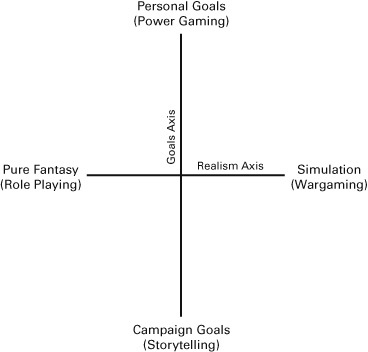
Jeffrey A. Johnson’s matrix based on the Blacow Model, from Different Worlds 11, 1981
Alarums & Excursions also published a questionnaire so players could find out their scores in different playstyles. This was seen to have practical value in calibrating expectations and forming gaming groups with similar interests. However, it was not yet thought to be used as a game design guideline. It is noteworthy that Blacow, like the Manifesto of the Turku School (2000), but unlike the Threefold Model (1997) or GNS theory (1999) understood character immersion as a thing of its own, separate from narrativism or storytelling.
The Elusive Shift is an interesting look at the early days of role-playing games. It challenges the idea that 1970s role-playing discourse was minimal or low-quality, and, like Playing at the World, is a product of great effort with primary sources. It is certainly not all-encompassing – one topic that is not discussed is the 1970s habit of playing the same characters in different DMs’ tables, which The Elusive Shift takes as a given that merits no further discussion. Guess something had to be left for the next book. That aside, The Elusive Shift is excellent, and unlike most academic books, reasonably priced. Strong recommendation for anyone interested in the history or theory of role-playing games.
This piece was first published in Finnish at roolipeliloki.com, on February 23rd, 2021. Translated by the author.
 Akateemiset pelaajat ry